
“Trading Cards of Grief, Badges of Joy”

How One Spirited Woman and a Circle of New Friends Showed Me Grief Isn’t the End

“Been there, done that…got the t-shirt.” This tongue-in-cheek quip came this week from an unlikely source in an unlikely place. There I was checking into a hotel in Atlanta on the eve of my first-ever widow’s conference. Sounds like a hoot, right?

Little did I know, standing at the front desk alongside a spunky, grey-haired woman decked out in dangly gold earrings and patriotic attire, that my life was about to take a sharp turn for the better. In short order, I learned she was an 86-year-old named Lucy, traveling alone from Florida (much to her daughter’s chagrin). She, too, was a widow. Her late husband Chuck, an Air Force veteran, had passed away within the year at 92.

In that moment, it became clear to me that grief truly knows no age. It doesn’t matter if you’re 23 or 92—the actual age range, I later discovered, of the women attending this conference. The ache of losing a spouse is just as deep and the impact just as profound no matter how many candles were on your last birthday cake.

The lobby quickly filled with women of all ages and backgrounds, each carrying her own story, but all united by the same purpose. Stepping into this circle of shared experience felt unfamiliar, yet the sense of belonging was immediate. We swapped hometowns and timelines of when our husbands had died like trading cards.

For once, I didn’t feel like the lone person in a crowd to be carrying this pit of grief in my stomach. I felt an instantaneous wave of relief wash over me. For these few days, none of us were alone. Very fitting, since the conference was sponsored by the Never Alone widow’s group.

With her check-in process completed, Lucy stepped away from the desk (one hand gripping her walker—another suggestion from her children, begrudgingly accepted), and she dug out a tattered Tupperware business card from her purse and handed it to me. She asked if I would call her later so we could meet up for dinner. No brainer.

That evening, Lucy joined a small group of widows I had previously connected with through various online widow’s pages and virtual grief groups (though most of us had never met in person until now). Lucy, quite frankly, stole the show—and our hearts. She kept us in stitches with corny bible jokes, snappy wisecracks and radiated a servant’s heart of pure gold.

Lucy truly became our conference “mascot.” Even though, like the rest of us, she bore the weight of losing her person, everywhere she went, she sparkled. She became instant friends with her fellow widows, her twinkling blue eyes, contagious smile and quick wit winning us all over.

The conference itself was a beautiful blend of camaraderie, prayer, teaching, music and—most importantly—the overwhelming assurance that, while this journey is painfully real for the 500+ women in that room, it doesn’t mark the end for any of us. There’s more out there. There’s hope. Grief isn’t the closing chapter. It’s the opening of something new.

By the end of the conference, as I watched widow after widow approach Lucy to get a picture with her (me included), I realized the “secret sauce” she so effortlessly embodies. We are meant to carry grief and joy at the same time, even when it feels impossible.

And one of those first lines she spoke to me, “been there, done that…got the t-shirt,” sums it all up. She’s worn both joy and pain like badges, proof that survival doesn’t just mean getting through it. It means collecting stories, forging friendships and wearing your experience proudly, even when it’s a little frayed around the edges.

Lucy—and all the women I was fortunate to meet and learn from at the conference—remind us that while grief may shape us, it doesn’t define us. We’re here to live. To laugh. To keep showing up, decade after decade, souvenir t-shirts and all. Because in this community, no one is ever truly alone. And that’s something worth wearing proudly.
“Loyal Hearts, Open Arms”

Honoring Friendship and Compassion When Grief Changes Everything

Growing up, it was impossible not to notice how my mom would drop everything to support friends and family, no questions asked. She lived by the motto, “to have a friend, you have to be a friend,” and that lesson stuck with me. Her unwavering loyalty became my blueprint, and I’ve always tried to show up for the people I love, no matter what storm I might be facing.

My mom’s steadfastness is something I deeply admired, and it’s undoubtedly one of the many reasons I was drawn to my late husband, Matt. No one embodied fierce loyalty quite like he did. He set the bar high, and if you were lucky enough to be on the receiving end, you knew it.

Everything is different now that these two pillars of loyalty are now in heaven. I am a different version of myself. Yet, my heart still has plenty of love and compassion for the people who have stuck by me and my family through it all. The tricky part? Sometimes, losing someone you love deeply can create an emptiness that quietly affects your other relationships too.

Our dearest friends and family, for instance, might hesitate to share their own struggles, thinking I’m already dealing with enough. But what they might not realize is that being excluded from their problems or even everyday ups and downs can feel extra isolating.

I know this is not intentional, and I’m truly humbled by the support and loyalty our friends and family have shown, especially through the worst moments of these past few years. Thank you doesn’t seem like enough. Now, I want the chance to “be a friend” and return the favor.

The thing is: you have to let me.

Even in the midst of heartache—I promise you—those of us grieving still want to be part of your world. But we can’t do it alone. So don’t hold back! Share your everyday drama, major dilemmas or funny little mishaps. We’re here, eager to stay connected and keep these bonds strong, no matter what life throws our way.

These connections aren’t just about reciprocating support for those who’ve stood by us (though that matters deeply). Staying involved also helps ease our loneliness and reminds us that, even as life changes, we remain a vital part of one another’s lives.

If you ever feel uncertain about leaning on someone who’s grieving, just remember that our loss doesn’t define us. We want to stand by your side, share in your joys and navigate both ordinary days and life’s toughest moments. That’s what true friendship is all about.

So, instead of tiptoeing around grief, let’s do our best to face it together. Let’s lean in and show up for each other, just as we always have. Life after loss may have changed me, but it hasn’t dimmed my loyalty or dampened my willingness to walk alongside you. Let’s choose connection and compassion, trusting that loyal hearts will carry us through—side by side, every step of the way.

“The Show Must Go On”

Performance After Loss: Everyday Life Unscripted

Over the holidays, my kids pulled me into a game on their phones I’d never played before called “Imposter.” The premise is simple: everyone gets the same secret word, except one person—the imposter—who doesn’t know what the word is. Each player tosses out clues, trying to figure out who’s faking it.

As they explained the rules, I had to laugh. The name of the game sums up how I’ve felt since my husband Matt died a year and a half ago. Most days, it’s as if I’m stumbling through life as an undercover imposter, hoping no one notices when I fumble my lines.

Grief has a strange way of making you feel like you’re starring in someone else’s movie with no script. One minute, I’m drowning in a flood of sadness, barely keeping my head above water. The next, I’m fueled by adrenaline, checking boxes, putting on a smile and hustling to “act normal”—as if I’m delivering an Oscar-worthy performance for everyone watching.

This instinct to put on a brave face isn’t just for the kids, or because Matt would want me to be happy (which he absolutely would). It’s because sometimes pretending is the only way forward. And what’s surprising is that sometimes pretending actually feels pretty great. There’s a weird freedom in stepping into the “old” version of myself, if only for a moment.

Ironically, Matt knew something about this too. During his cancer journey, he’d light up telling me about a conversation with someone who had no idea he was sick. For a little while, he could just be Matt. No pitying glances, no hushed tones, no “how are you feeling?” He could drop the role of “patient” and just enjoy being himself. I get that now in a way I didn’t before.

But here’s the real twist. Grief doesn’t just make you feel like an imposter; it can also change how people around you respond. I’ve found that sometimes friends and loved ones aren’t sure what to do. Some walk carefully around my emotions, hoping not to say the wrong thing, while others jump into cheerleader mode, eager to help even though there’s no easy fix. In the end, we’re all just improvising our way through the awkwardness together.

There’s a strange comfort in pretending, in slipping on the mask of “doing fine” even if it’s only temporary. And there’s even stranger comfort in knowing that everyone else is kind of pretending too. Trying to find their lines in a story none of us asked to be in.

Yet in the midst of all this uncertainty, there’s a quiet reassurance in realizing we’re all doing our best to show up for each other, one imperfect performance at a time. Even on the hardest days, we find connection and laughter in honest moments that remind us we’re not alone, and somehow the show really does go on.

“Nine Times the Memories”

Celebrating Connection Through Grief and Moving Forward

“What a difference a day makes,” as the old saying goes. Or a year. Or, in my case, nine. Yep, today marks exactly nine years since I first met my late husband Matt—at a Euchre fundraiser on the other side of the state—where, with a winning hand and charming smile, he trumped every expectation and turned my world in a new, wonderful direction.

If Matt were here right now and I told him that today was the ninth anniversary of us meeting, he’d undoubtedly grin and declare “…NIIIIIIINE TIMES,” quoting one of his favorite lines from Ferris Bueller’s Day Off. He never passed up a chance to make me laugh. Even now, heading into my second new year without him, I can’t help but crack up remembering how he relentlessly teased the people he loved most.

That’s the jovial spirit I’m determined to channel in 2026. I’m trying my best to set aside the ache I feel without him beside me at our daughters’ basketball games—where he’d be the loudest one cheering—or while watching football and basketball on TV, knowing he’d be animated as ever, dissecting every play or bad call with our sons.

I know Matt would want me to embrace the new year. Soak up every special moment with our kids and keep the laughter going with family and friends. And I’m doing my best to heed this advice, even when it’s tough. It’s hard to put into words, but grief seems to land differently as January rolls in, especially now, in this second year, with the initial haze gone and the reality of his absence settling in.

Moving Forward (Not On)

Despite the ache of missing Matt and the other challenges this flip of the calendar brings to my grieving heart, I’m choosing to cling to the hope of new beginnings. Even on days when memories appear out of nowhere and bring me to tears, I’m actively striving to keep going and take life one breath at a time.

Through this journey, I’ve found that connecting regularly with others who have lost spouses or partners has been a lifeline. While each of our stories is uniquely our own, there’s an unmistakable bond that forms through our shared losses, offering both comfort and encouragement as we navigate new paths. The understanding within this circle reminds me that I’m not alone, and it’s okay for grief to look different for everyone.

One such group I joined this year, fittingly called “Moving Forward,” is designed to help those of us feeling lost without “our person” find clarity, confidence and resilience. Its purpose isn’t to “move on” as if those we’ve lost are simply chapters closed, but to move forward with them still a part of us.

Matt’s influence remains woven into the fabric of who I am and who I’m becoming; his presence is never left behind. In fact, the group encourages each of us to seek out a “proving ground”—an activity, pursuit or adventure that demonstrates we are still growing, learning and embracing life mentally, emotionally, physically and even spiritually.

For me, writing this blog has become that proving ground. Putting my thoughts into words has been incredibly therapeutic, helping me honor both the laughter and the love that Matt brought into my life as I continue moving forward. Each post is a testament to my ongoing journey, reminding myself and others that healing doesn’t mean forgetting, but rather finding strength and meaning in the memories we carry.

Grief may not fade, but neither does the spark Matt lit in me—or the resilience it quietly builds. So, as we kick off a new year, here’s to making the most of each day, finding joy in laughter and letting hope outplay heartache. Because, as I learned all those years ago over a Euchre hand, what a difference a single day can truly make.

“It’s Not a Total Lie”

Finding Hope and Helpers Amid Life’s Struggles

“How are you doing?” Arguably the most frequently asked question in the English language. It’s pretty much the verbal equivalent of small talk autopilot. More of a reflex than a real question. Yet this seemingly simple, friendly conversation-starter is enough to make many a widow squirm.

Does the person asking really want to know how I’m holding up, or is this just a polite way to say “hello?” After chatting with plenty of fellow widows and widowers, I can safely say that this question makes almost all of us uncomfortable. No judgment to anyone trying to be nice, but here’s a little window into what it feels like on the receiving end.

Whether it’s been a week or two years since we lost our person, odds are we’re not exactly thriving. Our world got flipped upside down, and while life keeps spinning for others, ours is permanently changed. Yes, we’re doing our best to move forward and grab little pieces of happiness where we can, but if you’re asking how I’m really doing, are you sure you want the honest answer?

To give you a little perspective, whenever someone drops that question on me, my brain immediately goes into overdrive. I’m suddenly scrambling, asking myself how well I know this person or if it’s the right time and place to spill the real story. Are they hoping for the raw, unfiltered truth, or is it safer to stick with a breezy “I’m hanging in there?” At least that response isn’t a total lie, but it doesn’t exactly dive deep.

Truthful or not, I typically opt for the path of least resistance. So, here’s a little unsolicited tip as we head into the holiday season, which, to be honest, isn’t exactly “the most wonderful time of the year” for everyone dealing with loss. Skip the automatic “how are you?” and go for something real. Try a genuine greeting like “It’s great to see you” (if it truly is) or “Long time, no see!” It makes all the difference.

Look for the Helpers

Speaking of making a difference, this weekend’s church sermon took me straight back to one of the most comforting icons of my childhood: Mister Rogers. Kicking off the season of Advent, the pastor correlated the themes of hope and love with Mister Rogers’ unforgettable “look for the helpers” mantra. It’s all about the people who show up and step in when life gets messy, the ones who offer help when things crumble.

This message packs a punch because it’s grounded in love. It reminds us that even when life throws us curveballs, there’s always a current of kindness flowing through the cracks (if you intentionally look for it). Every time things fall apart, someone steps up with a small gesture, a quiet show of compassion or even just a smile. It’s proof that while heartbreak and hardship are part of the deal, so is the steady presence of human goodness and connection.

When you’re wrestling with grief and the world feels out of sync, those helpers – the ones who appear with a casserole, a text or simply a genuine “I’ve been thinking about you” – become lifelines. Their hope and love don’t erase pain and loss, but they certainly soften their sharp edges. It’s that mix of honest acknowledgment and everyday support that helps us keep going, even when we’re just “hanging in there.”

So, in a season obsessed with cheer, maybe real comfort comes not from surface-level greetings but from those small, true acts that say, “you’re not alone.” It’s the homemade treats dropped off at your door, the unexpected message that makes you feel remembered or the friend who sits beside you without needing words.

Sometimes, the greatest gift isn’t holiday sparkle or perfect joy. It’s simply the presence of someone who cares enough to show up, listen and let you be exactly where you are.

“Better Than We Found It”

How Everyday Thank Yous and Simple Gestures Make a Lasting Difference

With Thanksgiving right around the corner, I’ve been thinking more about gratitude, and it makes perfect sense that this was my late husband Matt’s favorite holiday. Sure, he was a sucker for the turkey, the mashed potatoes, having family all together, and, of course, watching the annual Lion’s game. But it was more than that.

We were about a year into dating when I discovered one of Matt’s remarkable habits. Every Monday morning, like clockwork, he’d pull five blank thank you notes out of his desk at work. Even amid his many responsibilities as a school superintendent, he made time every week to write out the notes. These weren’t boilerplate work emails or professional letters. They were genuine, handwritten thank yous to students, staff or anyone in the community who’d done something a little extra. Just his way of shining a light on others, simply because he cared.

And it didn’t stop there. As the head coach of our son Tynan’s travel baseball team, Matt’s post-game huddles were legendary (to me, anyway). I loved catching snippets of him talking to the boys as I folded up chairs and lugged snacks. With his classic blend of tough love and kindness, he challenged the boys to call out what they did well and where they needed to step up—always balancing grit with encouragement. And the part that truly resonated with me was when he’d finish his talk by reminding the team to clean up the dugout: “Let’s leave it better than we found it, boys.”

That was Matt to his core. Consistently brightening someone’s day with a thoughtful gesture or a gentle reminder to do a little good. Giving back wasn’t just a task to him, it was part of who he was. Matt devoted countless hours to community service, rolling up his sleeves for organized events or quietly assisting someone in need—never seeking recognition. He even volunteered as the announcer at our daughter Emma’s high school soccer games, a role he continued up until a month before he passed—always bringing his trademark energy, heart and humor.

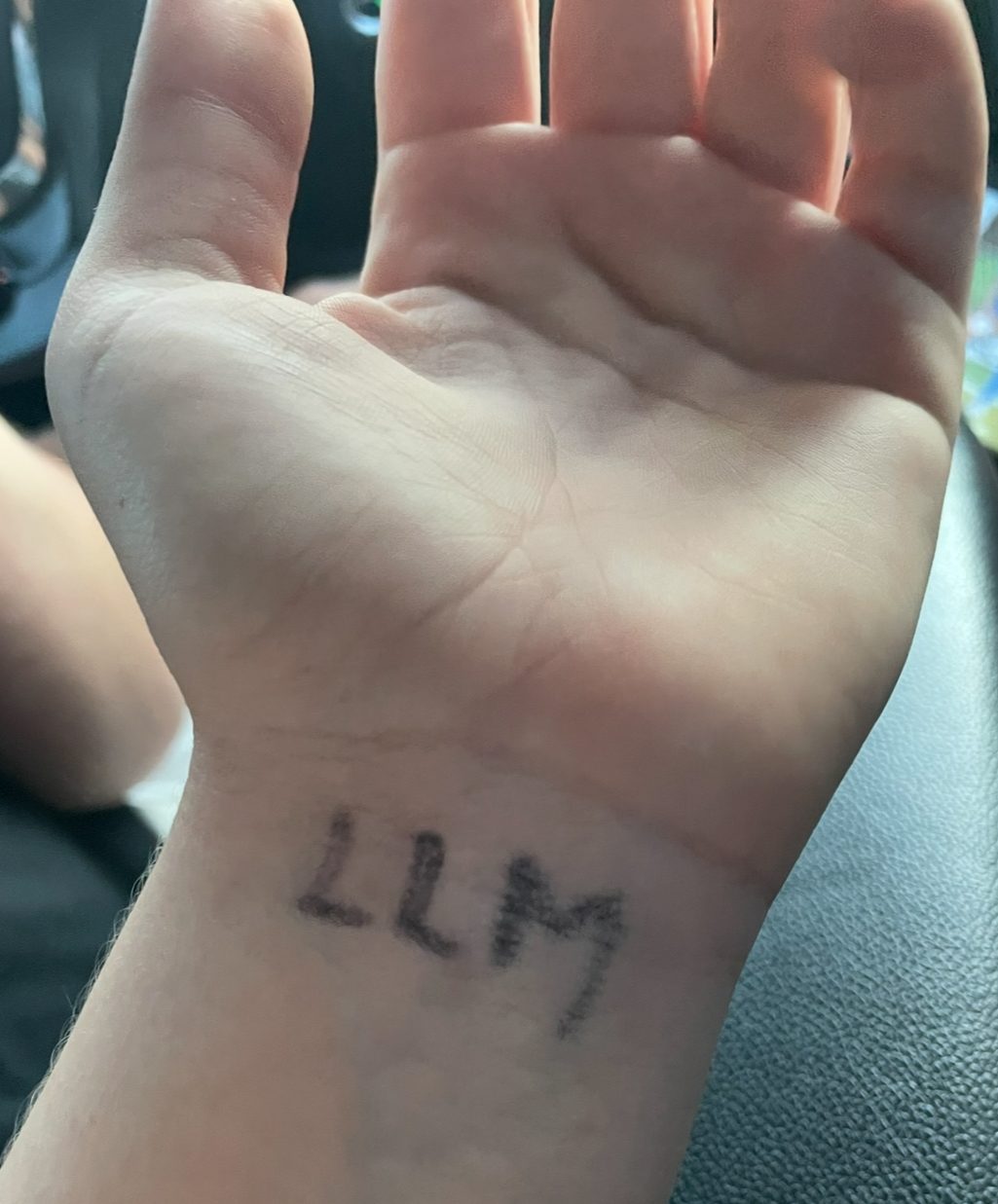
Though I doubt Emma’s soccer team knew much about Matt’s health struggles, they were certainly aware of his character, and the way he’d enthusiastically announce each name or proclaim that “a pack of huskies” were about to come out on the field. A week or two after Matt died, I attended the team’s District semi-final game with my friend. It was difficult to be there cheering the girls on without Matt by my side or hearing him announce. After the game, which they unfortunately lost, Emma and I were in the car, getting ready to leave when I noticed “LLM” written on her wrist in marker. At every game, the team did this with an acronym—usually some sort of competitive abbreviation to fire them up. When I asked her what the latest “tattoo” stood for, she said that one of her teammates came up with it and that it meant “Live Like Matt.”

I really love that motto. It’s simple, clear, and, honestly, exactly what we all need, especially as Thanksgiving rolls around. Matt showed us how to lead with gratitude, how to lift others up and how to leave the world just a bit better than we found it. He wasn’t perfect, but the way he lived taught me, our kids, and everyone lucky enough to know him that real thankfulness isn’t just reserved for the holidays; it’s something you carry with you, every day, in every little act. And for that, I’m truly grateful.

“The Fog Is Real”

Navigating Life’s Hazy Moments with Humor, Grace and a Little Help from Dad

I can still picture it. Me as a little girl, squinting into the grey mist outside as my dad grinned and announced, “It’s ‘froggy’ out!” That was his go-to fog joke, and he cracked it every time without fail. It’s just one of those quirky father-daughter moments that’s stuck with me. But fast-forward 40-some years and it’s a wonder I can recall that, considering I’m hard-pressed to remember what I had for breakfast this morning!

The struggle is seriously real. Over the past couple of years, I’ve started noticing all those “classic” aging brain blips—walking into a room and immediately forgetting what I went in there for or leaving the store without the one thing I actually needed. My late husband Matt never missed an opportunity to tease me during these moments (particularly when I frequently misplaced my phone). Nevertheless, I insisted that these things happen to everyone. That’s my story and I’m sticking to it.

But lately it’s gotten a little out of hand. In the past few days alone, I brought home the wrong item from Trader Joe’s (that I specifically drove there for), sent my Target pick-up order to a location on the other side of town and realized deep into a five-hour road trip that I had left my purse at home. Awesome.

When Memory Hops Away. . .

Not only are these occurrences making me feel like I’m losing my marbles, but they are also just plain annoying. Sure, I could chalk these things up to aging, perimenopause, not getting enough rest, spreading myself too thin, etc. Since the magnitude and frequency of these episodes has intensified since Matt died, they could also be attributed to “grief fog”—the mental haze that can happen days or even years after losing a loved one, where you can’t focus, can’t remember and feel like your brain’s stuck in low gear.

Regardless of the cause, I’m realizing—after being reminded by multiple friends—that I need to give myself a little grace. Amid the significant losses my family has endured over the past few years, life hasn’t exactly slowed down. It’s second nature for me to just keep trucking along, even when my brain and body are surely encouraging me to take a time-out.

Perhaps it’s time I listen. Not to say that I never take a break, but when life is happening at full speed around me and I’m feeling overwhelmed, I should probably stop and take a breather. Literally. I’ve often told my kids to “take a deep breath” when they have too much on their plate and need a moment to chill. It’s high time I heed my own advice.

So yes, the fog is real. And sometimes, it’s thick enough that you can lose your phone, your purse or even the thread of your own thoughts. Despite my recent moments of “frogginess,” my dad’s joke came full circle on the weekend when he hopped in (pun fully intended) and texted me a photo of my driver’s license so I could continue on after forgetting my purse. Thanks for saving the day, dad!

It’s one more reminder that we all need a little rescue now and then, and it’s okay to pause, breathe and offer ourselves the grace we’d so easily give someone else. Turns out, even in the fog, there’s always a way to find your way back—or at the very least, to laugh about it on the other side.

“Wearing the Love, Not the Loss”

Channeling What We’ve Lost into How We Live

This past week, I said goodbye to my grandma, my last living grandparent, who passed away at 99. Nearly a century packed with love and selflessness, she raised 10 kids and showered her 20 grandchildren and 28 great-grands with the sweetest attention. Her magical way of making everyone feel special—along with her cabinet brimming with “fun fruits” for visiting grandkids—is part of the joyful, generous legacy she leaves behind.

Funny enough, I was the only grandchild that never called her “grandma.” Ever since I was a toddler, she’s been “Gabby” to me. My grandpa jokingly encouraged this nickname as a nod to her “gift for gab.” As I grew older, I realized that she not only lived up to this moniker, but that I may have inherited her tendency toward chattiness.

Reflecting on the unique way this remarkable woman touched all our lives, I realize that each goodbye carries its own weight. As my kids would say, losing Gabby “hit different.” But not in a bad way. In fact, her passing felt like somewhat of a relief; she’s been asking for years why it was “taking God so long to call her home.” She’s now at peace, and I’m reminded that grief isn’t one-size-fits-all—it changes with the person and the story.

When my husband, Matt, died at the age of 48, grief felt like a tidal wave crashing down, relentless and suffocating. And some days it still does. With Gabby’s passing, I’m feeling more of a gentle ebb than a riptide. Missing her doesn’t pull me under—she was blessed with a long, full life, unlike Matt, whose time was heartbreakingly cut short.


Comparison is the Thief of Joy

But here’s what I’m learning: you can’t compare grief. It’s apples and oranges, heartbreak and heartache—each loss leaves its own mark. Our minds may try to stack our sorrows like a scoreboard, but there’s no winner. There’s no right way to mourn; every goodbye writes its own rules.

So, in the aftermath of loss, what if we rebel a little? What if, instead of shrinking under pain, we start weaving bits of the people we’ve lost into our everyday? Wear their unique qualities like armor and dive into life with their unstoppable spirit.

When I’m feeling a wave of grief coming on, I can channel Matt’s contagious laughter and obvious way of changing the subject in awkward silences. I can toss around Gabby’s favorite sayings like “my dogs are barking” or “nothing but the blues.” I can make Matt’s best-ever guacamole or bake Gabby’s famous banana cream pie.

Keeping their memory alive means living louder, loving harder and chasing every day with the kind of joy they’d want for us. That’s how we honor them—and how we remind ourselves that loss, as gut-wrenching as it is, can fuel a life lived even bigger.

“Breaking 48: Living Louder Than Loss”

A Birthday Rebellion Against Grief and Playing Small

This week, I turned 49. Let’s be honest, most people wouldn’t even blink an eye at that. It’s not a headline-grabbing birthday—everyone’s eyeing next year’s big 5-0, that infamous “over the hill” milestone. But for me, blowing out those 49 candles felt like a giant exhale after holding my breath for too long. And there’s a bigger story behind that sigh of relief.

I’ve mentioned in previous blogs that I’m more into words than numbers. So, call it irrational or superstitious or whatever you will, but for the past few years the number 48 has haunted me. It’s not just a number; it’s a line in the sand. Not only did my late husband pass away at this age, but so did my ex-husband. My two biological children lost both of their fathers at the way-too-young age of 48. Ugh.

So, for me, hitting 49 wasn’t just another birthday; it was my stake in the ground. A loud, rebellious shout against the shadows of grief. This birthday wasn’t just about adding a candle; it was about flipping the script. I’m here, living wide open—not just for my kids and myself, but for my late husband and ex-husband whose lives were cut short.

Most importantly, I want my children to see – in real time – that heartbreak can’t stop us from embracing life. It’s a promise to them. We don’t just survive after loss. We live, love and keep moving forward.

Carpe Every Damn Diem

I’ve never exactly been afraid of dying. In fact, since I met my father-in-law, I can’t help but grin whenever he cracks one of his favorite one-liners: “None of us are getting out of here alive.” It’s blunt, it’s true and it’s the ultimate reminder that we’re all on a one-way ticket. So, what’s the point of tiptoeing through life? Might as well go all in, squeeze every drop out of it and live it up while we can.

I can still picture my 13-year-old self, watching Dead Poets Society, and hanging on Robin Williams’ every word as he encouraged his students to “Carpe diem. Seize the day. Make your lives extraordinary.” Fast forward to my thirties, and suddenly everyone was shouting “YOLO”—you only live once. But honestly, it’s true. We get one go-around. Why waste it?

Particularly after losing Matt – someone who truly impacted so many and lived life to its fullest – I realized how fleeting life can be. His death taught me something that movie quotes and inspo slang never could: Life goes on, whether you’re ready or not. It keeps spinning, even if you’re sad, anxious or deep in grief. I can’t let my emotions slam the brakes on living—and that’s the lesson I want my kids to see in action, not just hear about.

Sometimes, the only way to heal is to push yourself into new experiences, to believe that the world has more to offer than pain or fear. That’s what I’m chasing now. So, while plenty of people cringe at the idea of turning 50, I’m not one of them. I’m charging into the next year, candles blazing, grateful and ready. Bring it on, big 5-0—you’ve got nothing on me.

“Weather Ball Green. . .No Change Foreseen”

Love, Loss and the Forecast of Resilience

In my last blog, I wrote about the weather ball—a literal beacon of light near my home with changing colors that predict the weather. Of course, if the forecast is favorable, we keep our fingers crossed for a green weather ball, indicating continued good weather ahead. But life isn’t like that. More often than not, we get the blinding, blinking weather ball forecasting stormy weather.

Grieving the loss of my husband, Matt, has been like stepping into a downpour – no warning, no umbrella – just me and the storm. Along the way, however, there have been occasional breaks in the clouds. Moments where I can catch my breath, accept that my life is forever changed, yet still manage to see the sunlight. But just when I think I’ve gotten used to the shifting weather of grief, along comes another cold front: the reality that everything’s about to change all over again.

With a new school year in full swing, I’ve been met with bittersweet feelings. While I’m excited for my kids and their new adventures, it’s also a time of sadness since Matt – a lifelong educator – can’t experience it with us. That, and the fact that fall was his favorite time of year—and mine. Football games, cooler weather, changing leaves. . .and did I mention football?

Flying the Coop

I thought back-to-school time last year was the ultimate gut punch—sending our oldest off to college just months after Matt died. On top of that, the rhythm of our household changed overnight as our scheduled time with my bonus kids shifted considerably, and what used to be a bustling home of six suddenly became two in the span of three months. But this year? A new set of curveballs. The house somehow feels bigger, quieter and a little emptier—and it’s only going to get more echoey.

Our oldest daughter has started her senior year of high school, which means next year at this time it’ll just be me in the nest. Not trying to have a pity party here, but this isn’t what I pictured. Social media wants me to “embrace” this empty nest era, but instead, I’m feeling a strange combination of sadness, nostalgia and trepidation for what’s to come.

Even with a chance of rain, I’m doing my best to steady my course—finding the strength to weather whatever comes next. I’m leaning into the whirlwind of college visits, senior Sunday posts, the last Homecoming, senior photos and other twelfth-grade milestones. I’m genuinely thrilled for what’s ahead for my senior (and for all my kids), but I’d be lying if I said the thought of what happens to me after they’ve flown the coop doesn’t weigh heavy.

Honestly, there was never a real blueprint for this stage—just the reassuring thought that, whatever came, I’d be tackling empty nesting with my best friend. Now? I’m winging it solo, and it’s a whole new forecast. But as Matt would sometimes say, I know this is my time to “suck it up, buttercup.” I’m scared as hell but know I can do it. As the ever-wise Bob Marley once said: “You never know how strong you are until being strong is your only choice.”

Resilience, I’m discovering, isn’t about waiting for clear skies—it’s about moving forward even when things feel overwhelming or uncertain. Some days bring doubts and anxiety, but I remind myself that these feelings are natural and don’t have to hold me back. Each day is a new opportunity to keep going, to show up for myself and my family, to honor Matt’s memory and to find strength in the progress I’ve already made.

While I certainly didn’t choose this part of my journey, I’m learning to dance in the puddles left behind by the storm. Even when the weather ball is anything but green, I’m making a conscious choice to seek out moments of laughter, love and resilience—guided by the hope of another break in the clouds.